Multi-Agent
Different agents handle different responsibilities. A Lead Agent coordinates work, Specialist Agents contribute expertise, and task-specific Subagents add capacity when needed.
MACS · Multi-Agent Cognitive System
MACS stands for Multi-Agent Cognitive System. It is Deepwork AI’s operating model for governed human–AI teamwork. It organizes specialist agents and accountable people as one organizational unit, supported by a shared cognitive layer for knowledge, memory, coordination, validation, and control. Orion applies MACS to complex sales.
The operating model
Different agents handle different responsibilities. A Lead Agent coordinates work, Specialist Agents contribute expertise, and task-specific Subagents add capacity when needed.
Agents help interpret information, reason through options, plan work, and retain useful knowledge across tasks.
Agents work through shared records, task dependencies, checks, and access controls. People set objectives and approve important decisions.
Design principles
Organize work around the team’s business goals and measure the combined result.
Keep reviewed information, decisions, and unfinished work available across conversations.
Define specialist roles around the requirements, decisions, and risks of a business function.
Set limits on the information, tools, and actions available to each agent.
Check work against sources and requirements. Use separate review steps to challenge findings before approval.
Give each task a clear objective, budget, and stopping point.
Architecture
Reference material, policies, capabilities, and evidence with links to sources.
Selected decisions, reasons, procedures, and lessons retained for future use.
The current facts, assumptions, risks, approvals, and progress for the work. In Orion, this is called Pursuit State.
Tasks, owners, dependencies, and next actions.
Checks for supporting evidence, completeness, consistency, and policy requirements.
Scaling MACS
A cognitive domain is a bounded field of work organized around one end-to-end outcome. Within it, people and AI share the concepts, knowledge, current state, decision rights, controls, and accountability needed to produce that outcome. Its boundary follows the outcome, not necessarily the organization chart.
Orion applies this model to the complex pursuit. Pursuit-specific decisions across sales, engineering, commercial, legal, risk, and delivery converge in one customer commitment and delivery handover.
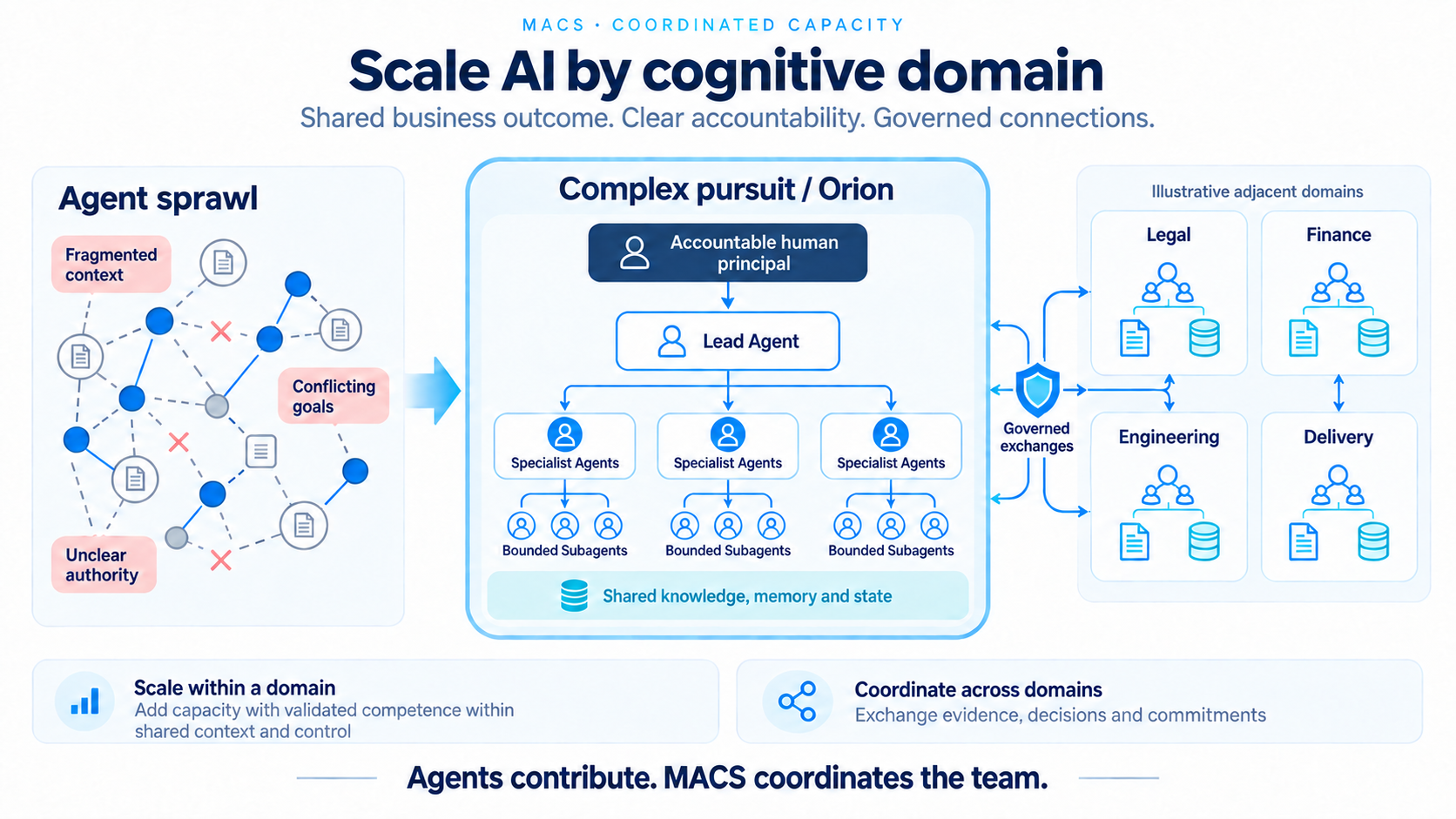
Add Specialist Agents, bounded Subagents, knowledge, skills, tools, and delegated responsibilities as competence is validated. Shared context and controls preserve coherence as capacity grows.
Establish a separate MACS for each adjacent cognitive domain. Connect them through governed exchanges of questions, evidence, decisions, and commitments. Each MACS retains its own authority, confidential context, controls, and performance measures.
Choosing an operating model
These models can overlap. The choice should depend on the work, required controls, and measured value.
For a person who needs help searching, drafting, or analyzing, a copilot may be enough.
For repeatable work with clear steps, an automated workflow may be appropriate.
For work that involves several specialists, changing information, and shared decisions, consider the MACS operating model.
Explore how specialist agents and shared information help teams prepare sales decisions.
See How It Works